October Blog
When Science Gets It Wrong (and Right)
💊
Recently, while teaching pharmacology, I was talking about paracetamol, and yes I could feel the collective eyerolls in the lecture hall. Everyone knows paracetamol. Everyone’s taken it, given it, prescribed it. What could I possibly say that they haven’t heard before?
Usually, I regain their attention when I tell them that we don’t know exactly how paracetamol works. And when I add that its discovery was a complete accident born of luck, chance, and a few errors people sit up a little straighter.
But paracetamol isn’t the only one with a strange origin story. (Don’t worry, I have a whole book planned on that for next year!)
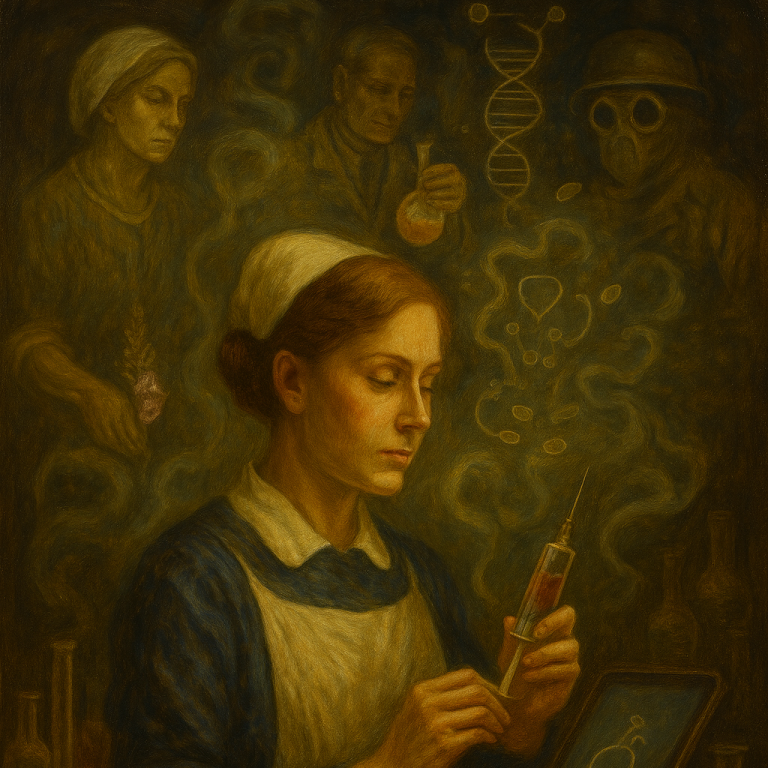
Despite our modern image of scientists in spotless labs, white coats, and orderly rows of test tubes, many of our most important medicines have murkier beginnings. Over the next few social media posts, I’ll be diving into a few of these, like mustard gas and chemotherapy, warfarin and mouldy hay, and foxglove and heart medication.
💊
I’ve always considered myself firmly on the side of science rather than tradition.
I’ve been known to glaze over when friends have mentioned homeopathy, herbal tonics, and “natural cures.” My prescribing lecturer once said something that’s always stayed with me:
“If drug companies are testing whale sperm for pharmaceutical properties, you can be sure they’ve already tested everything in your garden.”
I still stand by that. But, when you dig into history, medicine’s past becomes a little less clinical and a little more complicated.
Once upon a time, doctors genuinely believed cigarettes were good for you, and thalidomide was the perfect cure for morning sickness.
It makes you wonder what are we getting wrong today, despite our certainty?
💊
Look at what’s changed in just a few decades:
HIV is now a chronic, manageable condition instead of a death sentence.
A new treatment for Huntington’s disease offers hope where there once was none.
And the new generation of weight-loss drugs Ozempic and mount Jarrow are transforming lives.
But will we look back in 50 years and see unintended harm?
History says probably.
💊
Even Donald Trump has recently weighed in, claiming a link between paracetamol (Tylenol) and autism.
It’s a hugely emotive topic and with so many families affected by autism, it sparks strong feelings.
Is there evidence for the claim? Not really.
Is there evidence against it? Not strongly either.
As a clinician, my rational brain turns to the literature, weighs the studies, and concludes: it’s unlikely.
But if I were pregnant would I feel the same certainty?
Every parent knows the quiet fear of weighing risk versus benefit. We give our children vaccines knowing there’s a minuscule risk but also knowing the alternative could be far worse. Medicine is never risk-free, only risk-balanced.
So, is Trump “right” to raise the discussion?
Politically, I’m neutral as Im British, but scientifically, I think any open conversation about drug safety is worthwhile. We once were told that the MMR vaccine caused autism too until rigorous science proved otherwise. Perhaps, in time, we’ll see the same clarity for paracetamol.
💊
And speaking of caution, has anyone come across Dr Frances Kelsey, a unknown hero to many. In the 1960s, while European countries approved thalidomide for pregnant women, Kelsey refused to authorise it for use in the U.S. She insisted the safety data wasn’t convincing and she was right.
Her decision saved thousands of American babies from devastating birth defects.
She quietly stood her ground which I imagine must have been a hugely pressurised position to be in. This is one of my favourite reminders that science isn’t just about discovery it’s about doubt, caution and doing no harm.
💊
As nurses, clinicians, and teachers, we like to think of medicine as neat, evidence-based, and ever-improving and it is. But the truth is, our progress is built on trial, error, and the courage to question what everyone else accepts as fact.
From paracetamol’s accidental discovery to thalidomide’s tragedy, from mustard gas to chemotherapy, every breakthrough carries a shadow. And that’s what makes medicine so endlessly fascinating: it’s not perfect science, it’s human science.